
As franchise networks grow across markets, sustainability is shifting from a corporate responsibility initiative into an operational and financial priority, with major systems such as Yum! Brands, McDonald’s and Subway using energy efficiency, packaging redesign, waste reduction, responsible sourcing and supply-chain innovation to make sustainability work at franchise scale.
Sustainability is no longer a side project for large franchise businesses. It is increasingly becoming part of the machinery through which franchise systems manage costs, protect supply chains, respond to regulation and build brands that can continue to grow.
The scale involved explains why. Yum! Brands, for example, had more than 63,000 restaurants across 155 countries and territories in 2025, with approximately 97% of those restaurants independently owned and operated by franchisees. Its latest sustainability report says the company reduced Scope 1 and 2 emissions by 18% from its 2019 baseline, while emissions intensity at its corporate-owned restaurants improved by 40% over the same period. The company also reported packaging and waste initiatives including Taco Bell’s diversion of more than one million sauce packets from landfills since 2021 and Pizza Hut’s recyclable wing bowl in the U.S.
That example illustrates the central sustainability challenge in franchising: a franchisor can establish the strategy, but thousands of franchisees ultimately have to execute it.
The opportunity is enormous when that execution works. A small reduction in electricity consumption at one restaurant may barely register on its own, but the same improvement multiplied across thousands of locations can become a significant reduction in operating costs, resource consumption and emissions.
For franchise businesses, therefore, sustainability is increasingly about something much more practical than simply being environmentally responsible. It is about building an operating system that uses fewer resources, creates less waste and remains economically viable as the network expands.
The Franchise Model Makes Sustainability Both Difficult and Powerful
Unlike a conventional company-owned chain, a franchise network distributes investment and operational responsibility between the franchisor and franchisees.
The franchisor controls the brand, standards, approved suppliers, technology and operating framework, while franchisees are responsible for running individual units and absorbing much of the cost of equipment, labour, utilities and day-to-day operations.
This makes sustainability complicated because a corporate sustainability goal does not automatically translate into franchisee adoption.
Yum!’s latest sustainability report openly acknowledges this challenge. The company says that because franchisees own the majority of its restaurants, implementation and data collection vary by brand, market, ownership structure and local laws. Its response is to provide governance, standards, tools and shared capabilities while recognising that local conditions and the pace of adoption can differ.
This is arguably the most important principle for franchise sustainability: the initiative must work commercially at the unit level before it can work environmentally at network level.
A franchisee is far more likely to invest in energy-efficient refrigeration, LED lighting or water-saving equipment when the investment also lowers monthly operating costs and produces a measurable return.
Energy Efficiency is One of the Most Practical Starting Points
Energy is particularly important because restaurants, hotels, gyms, salons, convenience stores and other franchise businesses can operate equipment for long hours every day.
Lighting, refrigeration, HVAC systems, ovens, cooking equipment, hot-water systems and digital infrastructure all contribute to a location’s energy consumption.
This creates an opportunity for franchisors to build efficiency directly into the development model. Rather than asking franchisees to make sustainability decisions independently, a franchisor can specify energy-efficient equipment, establish minimum performance standards for new locations and introduce upgrade programmes during scheduled remodels.
Yum! provides a useful example of how this can be incorporated into a global franchise system. Its 2025 report says the company is advancing green-building principles across new and existing restaurants and is prioritising environmental actions that are scalable, measurable and workable for a global franchise network.
The commercial argument is just as important as the environmental one. Lower energy consumption can reduce recurring operating costs, while efficient equipment can potentially improve reliability and reduce maintenance requirements over its lifecycle.
For franchisees operating on tight margins, that makes sustainability much easier to justify.
Food Waste Represents Another Major Opportunity
Food waste is an especially significant issue for restaurant franchises because the environmental cost is accompanied by an immediate financial cost.
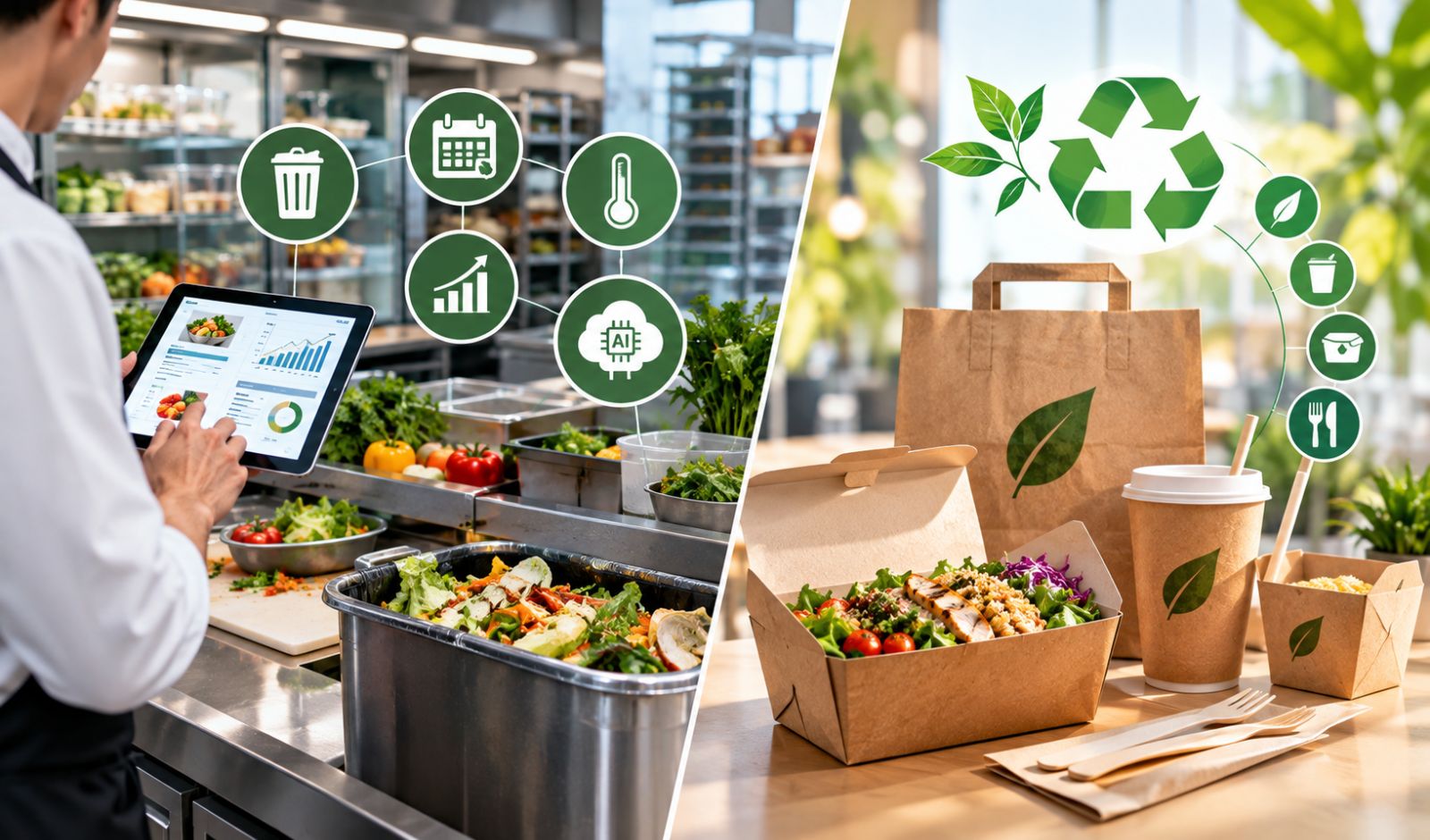
The U.S. Environmental Protection Agency estimates that approximately 66 million tons of wasted food were generated in the U.S. food retail, foodservice and residential sectors in 2019, with around 60% sent to landfills. Another 40 million tons were generated in food and beverage manufacturing and processing.
For restaurants, food waste can occur at multiple points: over-ordering, spoilage, preparation, incorrect portioning, unsold products and customer leftovers.
A franchise system can tackle these problems through standardised purchasing, inventory controls, demand forecasting and employee training.
Technology can make this more sophisticated. Sales data can help restaurants forecast demand by day and time. Inventory systems can identify ingredients approaching expiry. Digital kitchen-management systems can monitor preparation volumes. Artificial intelligence can potentially improve forecasting by combining historical sales with variables such as weather, holidays and local events.
The sustainability benefit is obvious, but so is the financial benefit: every ingredient that is purchased but never sold represents money that has left the business without generating revenue.
This is why food-waste reduction should not be treated purely as an environmental programme. It is fundamentally a productivity programme.
Packaging Has Become a Franchise-Wide Issue
Few sustainability questions are as visible to consumers as packaging.
Quick-service restaurants and takeaway franchises can distribute millions of cups, containers, bags, wrappers, lids and pieces of cutlery across their networks, meaning a relatively small packaging change can have a substantial cumulative effect.
McDonald’s provides one of the clearest examples. The company has been working toward sourcing 100% of its primary guest packaging from renewable, recycled or certified materials and has been redesigning products to reduce plastic, including paper-based straws, fiber-based salad boxes and cutlery and new packaging formats.
Its approach also demonstrates why packaging sustainability is more complicated than simply replacing plastic with paper.
McDonald’s says it considers safety, functionality, recyclability and local infrastructure, while working with suppliers and waste-management companies to develop solutions that can actually function in individual markets. In Poland, for example, its restaurants operate a closed waste-management system in which food-contaminated fiber packaging can be recycled, with the company reporting that the technology used with recycler Miklan-Ryza enables 95% of this packaging to be recycled.
That illustrates a broader lesson for franchisors: sustainable packaging is only useful if the entire system around it works.
A recyclable package that ends up in landfill because the local recycling infrastructure cannot process it does not deliver the same result as a package supported by an effective collection and recycling system.
Sustainable Procurement Can Protect the Franchise Network
Sustainability also reaches deep into the supply chain.
A franchise business does not simply consume electricity and packaging; it purchases ingredients, construction materials, furniture, uniforms, cleaning products, technology and equipment, often from hundreds of suppliers.
Responsible sourcing can therefore influence everything from agricultural practices and animal welfare to packaging materials and transportation.
Yum!’s 2025 report provides a particularly broad example. The company highlighted climate-focused supply-chain pilots involving beef, dairy, soy and chicken, including chicken-farm emissions-reduction pilots in France, as well as initiatives involving palm oil and soy. It also reported that approximately 93% of required suppliers had GFSI-recognised food-safety certification.
Subway similarly identifies energy efficiency, water and resource conservation, waste reduction, sustainable sourcing and supply-chain management as core areas of its sustainability approach, while explicitly noting the need for solutions that are sustainable and cost-effective for franchisees.
That last point is crucial.
A sustainable supply chain that dramatically increases franchisee costs without improving resilience, quality or efficiency is difficult to scale. A responsible supply-chain programme that also reduces waste, protects supply availability or improves purchasing efficiency has a much stronger commercial case.
Franchisees Cannot Be Left Out of the Sustainability Strategy
The biggest sustainability mistake a franchise brand can make is developing the entire programme at corporate headquarters and expecting franchisees simply to follow instructions.
Franchisees need to understand the financial and operational logic behind the change. Training is therefore important, but so are incentives, measurement and communication.
A franchisor could provide franchisees with energy benchmarks, waste targets and approved equipment lists, while giving them dashboards showing how their locations compare with similar stores.
The network can then identify high-performing locations and share their practices across the system.
This creates a sustainability feedback loop: headquarters establishes the framework, franchisees test it in real operating environments, performance data identifies what works, and successful practices are then replicated.
Yum!’s approach demonstrates the importance of this model. With around 1,500 franchisees operating the majority of its restaurants, the company describes franchisee collaboration as essential to delivering its sustainability ambitions at scale.
Technology Will Make Sustainability Easier to Measure
The next phase of franchise sustainability will increasingly depend on data.
Smart energy meters can identify unusual electricity consumption. Sensors can monitor refrigeration and HVAC performance. Digital inventory systems can track food waste. Procurement platforms can provide visibility into materials and suppliers.
The significance is that sustainability can move from an annual corporate report into the daily management of individual franchise units.
Imagine a franchise network where the franchisor can identify that one restaurant is consuming 25% more electricity than comparable locations, another is generating unusually high food waste and a third is purchasing substantially more packaging per transaction.
Those numbers turn sustainability into an operational management problem that can be investigated and corrected.
That is far more powerful than simply publishing an annual sustainability statement.
New Store Design Is an Opportunity That Should Not Be Missed
Sustainability should also begin before a franchise location opens.
New restaurants and retail units offer opportunities to incorporate efficient lighting, HVAC systems, insulation, water fixtures, refrigeration, renewable-energy solutions and lower-impact construction materials from the beginning.
Retrofitting an existing location can be expensive, whereas sustainability standards can be built into the initial development specification.
Franchisors can therefore establish minimum environmental standards for new stores while using remodels and equipment replacement cycles to gradually upgrade existing locations.
This approach also gives franchisees greater financial predictability because sustainability investments can be planned alongside normal capital expenditure rather than introduced unexpectedly.
Global Brands Need Local Sustainability Strategies
International franchisors face another complication: sustainability infrastructure varies dramatically between markets.
A packaging solution that works in the United Kingdom may not work in India. Recycling infrastructure differs between cities. Energy grids differ between countries. Water availability varies by geography. Environmental regulations also continue to evolve.
The solution is not necessarily to abandon global standards but to combine global principles with local implementation.
The principle might be reducing single-use materials, improving energy efficiency or increasing responsible sourcing; the actual solution can then be adapted to local infrastructure.
McDonald’s packaging strategy illustrates this approach, with the company acknowledging that recycling infrastructure and consumer behaviour vary across countries and locations while pursuing locally relevant solutions.
The Future of Franchise Sustainability Is About Business Resilience
The strongest franchise sustainability strategies will ultimately be those that connect environmental responsibility with business performance.
Yum! explicitly describes its sustainability work as part of its broader business strategy, linking it to operational efficiency, risk management, resilience and franchisee growth.
That shift is important because sustainability can no longer be treated as something that exists separately from franchise economics.
Reducing energy use can reduce costs. Reducing food waste can protect margins. Better packaging can reduce material consumption. Responsible sourcing can strengthen supply resilience. Efficient buildings can reduce long-term operating expenses. Data can identify inefficiencies before they become expensive problems.
For franchisors, the challenge is therefore not simply deciding whether sustainability matters. The more important question is how sustainability can be designed into the franchise system so that franchisees can afford it, employees can execute it and customers can recognise its value.
The answer will differ by sector, but the principle is increasingly universal.
The next generation of sustainable franchise businesses will not necessarily be those with the most ambitious environmental slogans. They will be the brands capable of embedding sustainability into procurement, store design, equipment, technology, training, supply chains and franchisee economics, and then measuring whether those changes actually work.
Because franchising is fundamentally a model of replication, its sustainability opportunity is equally about replication: one efficient restaurant is a good start; thousands of efficiently operated restaurants can become a genuine business strategy.