
Ghost kitchens are moving franchising beyond storefronts, allowing food brands and franchisees to scale through delivery-first locations, shared infrastructure and multiple digital brands under one roof.
The next franchise restaurant may not need a dining room, a high-street location or even a sign outside the door. It may exist almost entirely on a delivery app.
Ghost kitchens, also called cloud kitchens, dark kitchens or virtual kitchens, are professional facilities designed solely for preparing takeout and delivery orders, with no customer dining space. What began as a pandemic-era survival tactic has matured into a distinct franchise model. Lower capital requirements, multi-brand operations from a single kitchen and rapid scalability have attracted both entrepreneurs and established restaurant groups seeking to expand with less dependence on traditional real estate.
The opportunity is substantial. Credible estimates place the global ghost kitchen sector in the $70–85 billion range in the mid-2020s (IMARC valued the cloud kitchen market at $85.5 billion in 2025). Projections range from roughly $140–220 billion by 2030–2034 at compound annual growth rates of 10–13% or higher, depending on the research firm and definition used. Asia-Pacific already generates a large share of revenue, driven by massive order volumes on platforms such as Meituan and dense urban demand in China and India. Meanwhile, Grand View Research estimates the broader global online food delivery services market at $380.4 billion in 2024, projected to reach $428.2 billion in 2026 and $618.4 billion by 2030. Definitions vary across studies, some include virtual brands operating inside existing restaurants, shared facilities and dedicated delivery-only sites, yet the direction is clear: foodservice is becoming increasingly digital, and franchising is adapting with it.
What Exactly Is a Ghost Kitchen Franchise?
A traditional restaurant franchise typically requires a full front-of-house build-out, dining space, parking and significant real-estate investment, often $750,000 to well over $1 million. A ghost kitchen franchise strips away the customer-facing elements. Operators focus on kitchen production, packaging optimised for delivery and digital visibility on third-party platforms such as DoorDash, Uber Eats, Deliveroo, Swiggy, Zomato, Meituan, Rappi and local services.
Orders arrive digitally, are prepared to the franchisor’s specifications and handed to delivery partners. Several overlapping models exist:
- Shared or commissary kitchens: Franchisees or independent operators rent equipped space by the hour or by station from a landlord such as CloudKitchens.
- Multi-brand virtual kitchens: One physical kitchen runs several delivery-only brands under different names and menus, maximising throughput and spreading fixed costs.
- Host or combo kitchens: Existing brick-and-mortar restaurants license additional virtual brands to fill spare capacity during slower periods.
- Managed or full-stack platforms: The franchisor supplies the brand portfolio, recipes, supply chain, technology stack and marketing support in exchange for an initial fee and ongoing royalties (commonly 6–15% of sales).
Startup costs frequently range from roughly $30,000–$100,000 at the low end to $194,000–$515,000 for more structured franchise systems, still a fraction of traditional restaurant outlays. Reported industry profit margins often sit in the 10–20% range when operations are tightly controlled, though platform commissions (often 20–30%), packaging and labour remain major cost pressures.
Why Franchising Suits the Model
Franchising accelerates geographic coverage without the franchisor having to own every kitchen. Franchisees bring local knowledge, capital and operational labour; the franchisor provides tested brands, standardised processes, technology integrations and marketing support.
The multi-brand approach is especially powerful. A single kitchen can serve burgers under one virtual name, pizza under another and healthy bowls under a third, improving asset utilisation and allowing rapid testing of demand. Data analytics, order aggregation software and increasingly AI-
driven forecasting and kitchen automation are becoming key differentiators. Systems that help operators manage multiple platforms, keep food cost tightly controlled (ideally under 30%) and drive repeat orders tend to perform better.
For international expansion the model offers particular flexibility. A brand can enter a new country through a smaller delivery-oriented site, gather customer data, refine the menu for local tastes and only later commit to larger customer-facing locations if demand justifies it.
Global Examples in Action
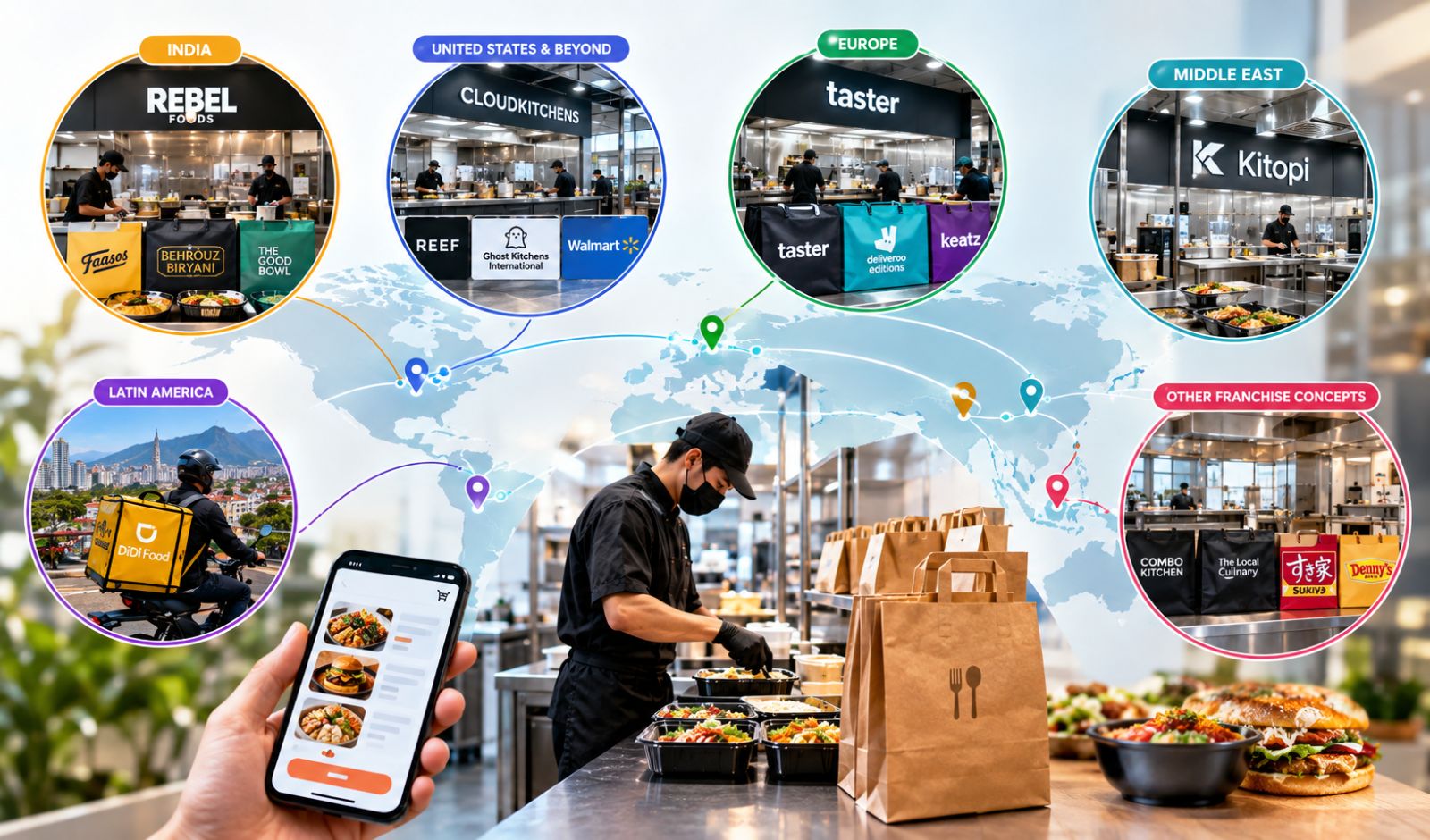
India – Rebel Foods
One of the clearest large-scale success stories. Rebel Foods operates more than 45 own and partner brands (including Faasos, Behrouz Biryani, The Good Bowl, Lunchbox and The Biryani Life) and reports 4,000+ internet restaurants across 80+ cities globally. Its philosophy centres on “one cloud kitchen = multiple restaurant brands.” In an earlier phase it scaled seven delivery-only brands across 176 kitchens in 15 Indian cities, allowing restaurant count and revenue to grow faster than the physical kitchen network. Franchise partners gain access to technology, kitchen blueprints, supply-chain systems, training and operating processes; master-franchise options are also available. Existing operators can “cloudify” an established food business by adding delivery-only concepts to current infrastructure.
United States & Beyond – CloudKitchens, Ghost Kitchens International and REEF
CloudKitchens, associated with Travis Kalanick, pioneered the “kitchens-as-a-service” landlord model, leasing fully equipped, permitted spaces to operators. Ghost Kitchens International (formerly Ghost Kitchen Brands) has pursued a franchise route, including partnerships that place kitchens inside retail locations such as Walmart, and has expanded from North America into Europe. Investment ranges have been disclosed in the mid-hundreds of thousands of dollars, with royalty structures around 6%.
REEF helped establish neighbourhood-based delivery kitchens that could host multiple restaurant concepts. It announced a partnership with Wendy’s covering 700 delivery kitchens across the US, Canada and UK, and worked with C3 concepts such as Umami Burger, Krispy Rice and Sam’s Crispy Chicken, some kitchens producing food for as many as six brands. The model later encountered significant operational and financial challenges, leading REEF to evolve beyond a pure-play ghost-kitchen operator. The experience underscores that delivery-only formats do not eliminate restaurant economics; they simply relocate the costs and risks.
Europe – Taster and Regional Players
French operator Taster runs multi-brand kitchens (the large majority of its sites operate several concepts) and has grown through a mix of company and partner-operated locations, ranking among the top restaurant groups on local delivery platforms. Deliveroo Editions in the UK and concepts such as Keatz have similarly expanded dedicated delivery capacity across European cities.
Middle East – Kitopi and Regional Dynamics
Dubai-based Kitopi has built a managed cloud-kitchen network spanning multiple countries, combining operational expertise with virtual brands. The Middle East and Africa cloud-kitchen market was estimated at about $427 million in 2024 and is forecast to reach approximately $1.07 billion by 2030. High urban density, extensive delivery infrastructure and a strong international franchise presence make the region a natural fit for delivery-led concepts.
Latin America
In markets such as Mexico, Colombia and Argentina, restaurants increasingly treat delivery applications as primary digital storefronts. A 2026 analysis notes that the model has matured beyond the initial boom, with operators in cities including Buenos Aires, Bogotá and Mexico City running multiple virtual brands from individual kitchens. Mexico has emerged as particularly active; DiDi Food data cited in 2025 showed the country accounting for 67% of global ghost-kitchen orders on its platform, with those orders growing 58% during 2024.
Other Franchise Oriented Concepts
Combo Kitchen and The Local Culinary in the US offer franchisees access to portfolios of licensed or partnered brands so one kitchen can serve many cuisines. In Japan and other Asian markets, specialised ghost-restaurant franchise systems have proliferated, often with relatively low entry fees and support for rapid launch on delivery platforms. Traditional chains have also experimented: Denny’s struck deals with matchmaking platforms such as Franklin Junction to expand virtual reach without building new dining rooms.
Advantages, Risks and Realistic Expectations
Advantages include dramatically lower capital intensity, faster time-to-market, the ability to test multiple concepts, and the capacity to locate kitchens in lower-rent industrial or suburban zones while still serving dense delivery demand. Shared facilities further reduce overhead. For multi-unit and master franchisees the model creates a more flexible development pipeline, particularly in high-density cities where prime retail is expensive.
Risks are material. High tenant or concept churn has been reported in some shared facilities, one analysis of CloudKitchens locations found average annual turnover near 65%. Thin margins after platform fees, packaging and labour leave little room for error. Brand differentiation is harder without a physical presence; success hinges on digital marketing, menu engineering, consistent quality, strong photography, ratings management and data-driven decisions. Some heavily funded pure-play operators scaled aggressively and later retrenched or pivoted when unit economics failed to materialise.
Customer acquisition is more difficult because a ghost kitchen is largely invisible and must compete inside delivery apps. Dependence on third-party platforms can limit ownership of the customer relationship and expose operators to changing commission structures. Regulatory requirements, food safety, zoning, ventilation, waste disposal, fire codes and licensing, vary significantly by country and city. Not every concept belongs in the format; delivery-friendly categories such as pizza, burgers, bowls, biryani, fried chicken and desserts adapt more readily than fine-dining experiences built around ambience.
Successful operators typically emphasise tight food-cost control from day one, limited initial menus focused on high-margin items that travel well, multi-platform presence, and continuous monitoring of order volume, average ticket and repurchase rates.
Technology Is the Backbone
Ghost kitchen franchising is fundamentally a technology-enabled model. Successful operations require digital ordering, kitchen-display systems, point-of-sale integration, inventory management, delivery coor
dination, customer analytics and increasingly sophisticated demand forecasting. Academic research has highlighted the complexity of coordinating food preparation with delivery so that food remains fresh while arriving quickly. The strongest systems therefore compete on operating platforms as much as brand recognition: how quickly an order moves from app to kitchen, how accurately demand is forecast, which menu items travel best, and which brands share a kitchen most efficiently.
Localisation Becomes More Important, Not Less
Digital restaurants cannot simply copy a successful menu into another country. Food preferences, portion sizes, pricing, dietary requirements, delivery habits and platform economics differ substantially. Rebel Foods has developed local concepts such as Holy Cow! in the UK, a Lebanese-focused brand in the UAE and Box n Co in Indonesia, showing how cloud infrastructure can support market-relevant offerings rather than exporting one unchanged menu. A kitchen can function as a local innovation laboratory, testing different menus, price points and digital brands at smaller scale before larger commitments.
What the Model Means for Franchisees and Global Expansion
For entrepreneurs the model offers a lower-barrier entry into food franchising, providing access to established brands, recipes, training, procurement, technology and marketing support without the full cost structure of a conventional restaurant. Critical questions remain: actual kitchen setup costs; royalty, technology and platform fees; ownership of customer data; share of sales through aggregators; delivery territory size; efficiency of multi-brand labour and equipment sharing; provisions for underperforming brands; and whether a location can later convert to a traditional restaurant.
Ghost kitchens are unlikely to replace conventional franchised restaurants. Instead they form another layer in the expansion toolkit. A global brand can enter a market through a delivery-only kitchen, establish demand and brand awareness, then open conventional locations once potential is proven. An existing franchisee can add virtual concepts to current infrastructure for incremental sales. Master franchisees can build networks of smaller production kitchens rather than relying exclusively on large storefronts.
The Road Ahead
Ghost kitchen franchising is no longer experimental. It is a structural response to sustained consumer preference for convenience, the economics of urban real estate and the power of delivery platforms. Asia continues to lead in absolute scale and growth velocity; North America and Europe offer more mature infrastructure and higher average order values; Latin America and the Middle East show rising activity.
The philosophical shift is significant. For decades restaurant franchising focused on replicating physical locations. Ghost kitchens emphasise replicating operating systems—kitchen capacity, digital storefronts, delivery territory, technology stack, supply chain and brand portfolio. Operators who treat these facilities as data-driven production businesses rather than simply “restaurants without chairs” are best positioned to thrive.
The delivery-first restaurant is here to stay. Franchising is turning it into a scalable, global business model.