
From a secondary expansion tool to one of the country’s most powerful platforms for organised growth, employment and wealth creation.
India is no longer simply adopting the franchise model, it is reshaping it. What started largely as a channel for global quick-service brands has matured into a sophisticated, multi-sector system that ranks as the world’s second-largest franchise market. Growth is increasingly powered by homegrown concepts that understand local tastes and price points, by hybrid and asset-light formats that lower entry barriers, and by a decisive shift toward Tier 2 and Tier 3 cities. Entrepreneurs are choosing proven systems over pure startups; brands are choosing capital-efficient network expansion over heavy company-owned rollouts. The result is a more democratic, resilient and faster-scaling form of organised enterprise.
This article examines the current market reality, the structural forces accelerating expansion, the sectors and cities leading the next wave, standout examples of successful models, and the practical opportunities and risks facing both franchisors and franchisees.
Market Size and Growth Trajectory
The Indian franchise industry is valued at approximately USD 47–48 billion and is projected to reach USD 140–150 billion by around 2028, supported by annual growth of 30–35%. More than 4,600 active franchisors operate nearly 200,000 outlets. Over 53% of these locations are run by multi-unit franchisees. The sector employs an estimated 5.5–6 million people and contributes close to 2–3% of national GDP. Around 300 companies adopt the franchise model every year.
Regional brands account for roughly 50% of the market, national brands 34%, and local concepts the remainder. Food & beverage still represents about 35% of franchise concepts, while education, retail, wellness and services are expanding rapidly. Even under narrower tracking metrics, the sector has shown consistent momentum, rising from roughly INR 4,500 crore in 2018 to an estimated INR 12,500 crore by the end of 2024.
Structural Drivers Powering Expansion
Several reinforcing forces are accelerating growth:
- Rising disposable incomes and aspirational consumption, especially in smaller cities, are increasing demand for standardised, hygienic and branded experiences.
- The bulk of volume growth is shifting to Tier 2 and Tier 3 markets, where nearly half of recent franchise openings have occurred.
- Government programmes such as Startup India and Skill India are lowering entry barriers and improving access to finance and training.
- Brands prefer rapid, capital-light expansion while entrepreneurs seek de-risked systems with ready processes, supply chains and marketing support.
- Digital tools — order management platforms, inventory dashboards, remote training and real-time analytics — have made multi-location consistency far more achievable than a decade ago.
These drivers collectively reduce friction and enable faster, more disciplined network expansion across a wider range of cities and investor profiles.
Sectoral Depth and Emerging Formats
Food & Beverage remains the largest category, yet it is no longer limited to global burger or pizza chains. Homegrown concepts that understand regional tastes and price points are scaling aggressively, while cloud-kitchen and hybrid dine-in models reduce real-estate intensity.
Education and Skilling benefit from India’s large young population and parental focus on structured early learning and vocational skills. Preschool and after-school formats generate recurring revenue and perform well in residential catchments of emerging cities.
Retail and Lifestyle covers eyewear, value fashion, jewellery and specialty formats that leverage strong supply-chain control and omnichannel integration.
Services and Wellness such as salons, fitness centres, diagnostics, laundry, automotive care and fitness — deliver high-repeat, relatively recession-resilient unit economics and work across both metro and non-metro locations.
Micro-franchise and kiosk formats have further lowered capital thresholds, allowing first-time entrepreneurs and multi-unit operators to participate in the same ecosystem.
Global Brands Anchoring Standards and Scale
While Indian brands are increasingly driving volume and innovation, international players remain a critical pillar of the franchise ecosystem. They bring proven systems, rigorous training protocols, supply-chain discipline and brand equity that help raise overall industry standards.
Major global concepts operate almost exclusively through master franchise or joint-venture structures rather than direct company-owned expansion. Domino’s Pizza, managed by Jubilant FoodWorks, has built one of the largest Domino’s networks outside the United States, with well over 2,300 stores and continued aggressive expansion. McDonald’s operates through two long-standing master franchisees; Westlife Foodworld (West & South) and Connaught Plaza Restaurants (North & East), steadily adding outlets and formats such as McCafé while adapting menus and store sizes for Indian consumers. Yum! Brands (KFC and Pizza Hut) via Devyani International and other partners, along with players such as Burger King, Subway, Starbucks (Tata Starbucks) and newer entrants, further deepen the organised QSR and café landscape.
These international brands contribute in several important ways:
- They introduce and enforce high operational, hygiene and customer-experience standards that local franchisees and competing homegrown brands must match.
- Their large multi-unit franchisees create sophisticated local operating companies that later develop or acquire additional brands.
- They accelerate the professionalisation of real-estate selection, training academies and performance analytics across the wider sector.
- Their continued investment signals confidence in India’s long-term consumption story and helps attract further foreign concepts.
Importantly, most successful global brands have heavily localised, vegetarian menus, smaller footprints, aggressive delivery focus and pricing strategies tailored to Indian value expectations. Their presence does not crowd out Indian concepts; instead, the two segments increasingly complement each other. Global brands anchor the upper end of operational excellence and brand trust, while homegrown players capture regional tastes, lower capital thresholds and deeper Tier 2/3 penetration.
Together they form a balanced, competitive and rapidly maturing franchise market.
Geographic Rebalancing: Tier 2 and Tier 3 as Primary Growth Engines
Metros such as Delhi, Mumbai, Bengaluru and Hyderabad still matter for brand visibility, high-throughput stores and concept testing. The real volume engine, however, has moved decisively outward. Tier 2 and Tier 3 cities now account for a large and rising share of net new openings.
Markets such as Indore, Lucknow, Coimbatore, Jaipur, Surat, Kochi, Vijayawada, Bhubaneswar and Dehradun illustrate the opportunity. They offer lower rents and labour costs, faster break-even periods (often 12–18 months versus 24–36 months in high-cost locations), growing brand awareness and relatively lower competitive intensity.
Consumers in these cities increasingly expect the quality and consistency found in larger cities, yet remain more price sensitive. Successful brands adapt rather than simply replicate metro formats, using smaller or flexible footprints, localised menus or pricing, hybrid dine-in and delivery models, and right-sized education or service centres.
Challenges persist: talent readiness, last-mile logistics, supply-chain reliability and infrastructure variability. Leading franchisors address them through regional training hubs, digital SOPs, remote monitoring, flexible real-estate guidelines and rigorous local partner selection. Strategies that treat these markets as residual will underperform; those designed around their realities are capturing the bulk of incremental growth and often superior returns.
Homegrown Champions: Brands Proving Local Fit and Unit Economics Win
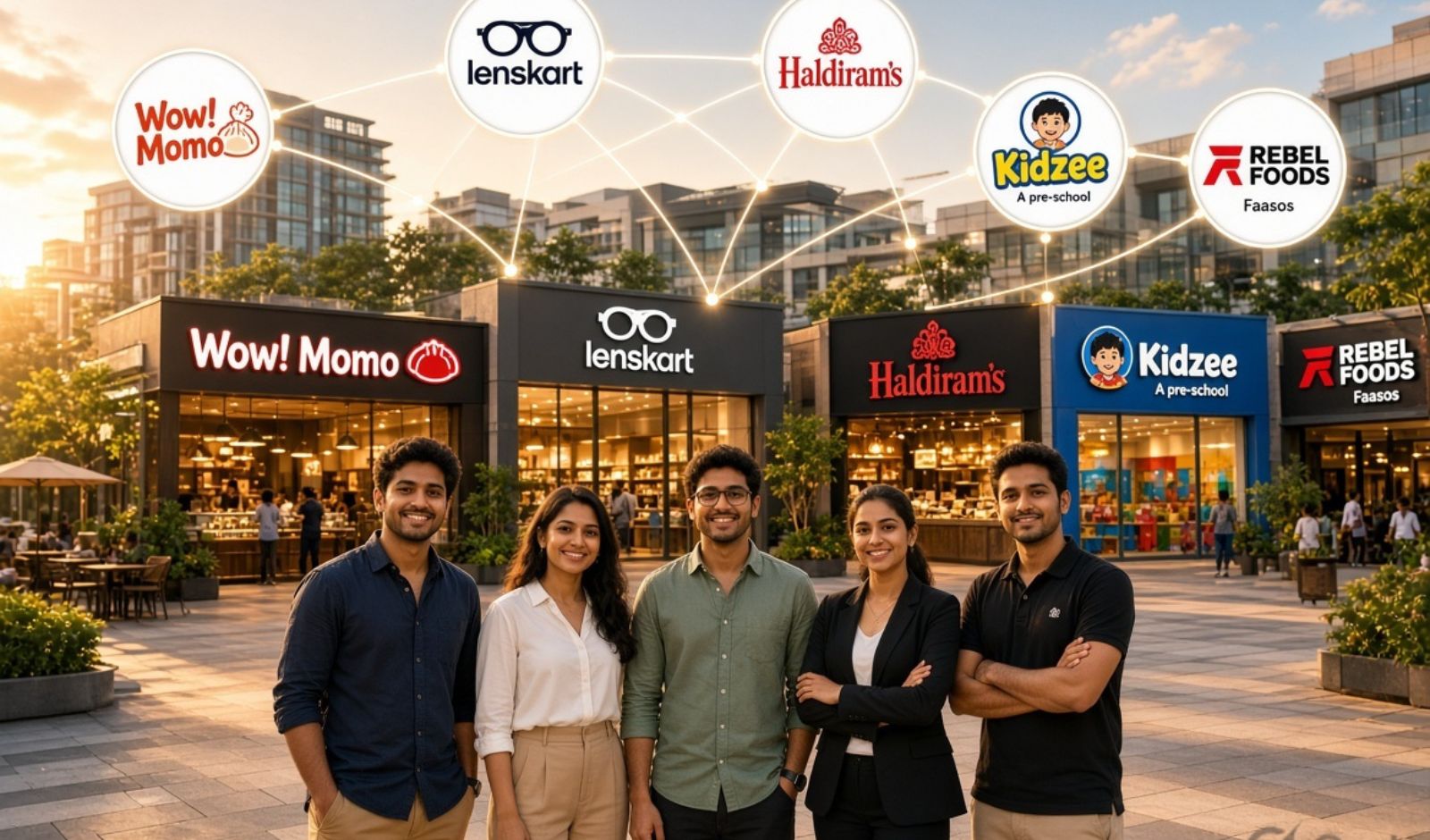
Wow! Momo began as a single kiosk in Kolkata and has grown into one of India’s most successful homegrown QSR stories, with more than 650 outlets across 35-plus cities. Investment typically ranges from ₹20–35 lakhs for compact formats. The brand has expanded into adjacent concepts and achieved unicorn status by standardising a popular street food while continuing to innovate.
Lenskart has built one of India’s largest organised eyewear networks, with well over 2,000 stores in India and meaningful presence beyond the metros. The model combines company-owned and franchise formats, vertical integration and strong omnichannel capabilities. Entry capital for exclusive store formats can start around ₹15 lakhs in some configurations.
Rebel Foods pioneered large-scale cloud kitchens under brands such as Faasos, Behrouz Biryani and Oven Story. It operates hundreds of kitchens and has opened franchise pathways that combine dine-in with multi-brand cloud capabilities. Hybrid formats typically require ₹90 lakh–1 crore.
Haldiram’s leverages deep category leadership and consumer trust in ethnic snacks and sweets. Restaurant and kiosk franchise opportunities (primarily through the Nagpur entity covering South, West and Central India) allow partners to access one of India’s strongest food brands, with investment varying widely by format.
Kidzee (Zee Learn) remains a benchmark in early childhood education, with approximately 1,900–2,000 centres. Investment typically ranges from ₹12–20 lakhs. The model benefits from high parental trust, standardised pedagogy and recurring fee income, performing especially well in residential areas of Tier 1 and Tier 2 cities.
Other notable platforms include regional pizza and waffle concepts, accessible chai and snack formats, and value retail or service brands that prioritise compact, high-throughput stores. These examples underline a clear shift: lasting franchise success in India now rests less on global brand recognition and more on unit economics, operational support, supply-chain reliability and genuine local fit.
Opportunities Across Investor Profiles
Entry points span a wide spectrum:
- Low-to-mid capital (₹5–40 lakhs): kiosks, compact QSR, preschool, chai concepts and basic service formats.
- Mid-range (₹40 lakhs–1.5 crore): full QSR outlets, hybrid cloud + dine-in, specialised retail and larger education centres.
- Higher capital or multi-unit/master development: established ethnic food restaurants, premium lifestyle formats or exclusive territorial rights.
The most attractive brands offer transparent unit economics, robust training and ongoing support, controlled supply chains, and proven performance in similar city tiers. Multi-unit operators and those with local market knowledge are often preferred. Reverse franchising — successful Indian brands expanding overseas — is emerging as a longer-term opportunity.
Challenges and Practical Risk Mitigation
Key risks include uneven franchisee capability, real-estate quality, supply consistency outside major cities and intellectual-property enforcement in smaller markets. India lacks a dedicated franchise statute; relationships are governed primarily by the Indian Contract Act, Trade Marks Act, Competition Act, Consumer Protection Act, FEMA (for cross-border royalties) and related legislation.
Careful review of territory rights, royalty structures, performance obligations, termination clauses and exit provisions is essential. Thorough due diligence — reviewing financials of existing outlets, quality of support and realistic projections — remains the most effective risk filter.
Outlook
India’s franchise market is moving from rapid volume growth toward higher-quality, more professionalised expansion. Homegrown concepts that solve real local problems at accessible price points, hybrid digital-physical models and high-repeat service formats are likely to outpace purely imported templates. Tier 2 and Tier 3 cities will continue to absorb the majority of new outlets.
For entrepreneurs, the model offers a structured route into ownership with lower failure risk than independent startups, provided brand evaluation is rigorous and local execution is disciplined. Franchising in India is no longer about importing global formats. It is increasingly about building and scaling systems that understand Indian consumers, cities and capital realities at a granular level. Those who master that combination will capture the most durable value in the years ahead.