
Chinese-made wigs, extensions, press-on nails and beauty accessories are moving from factories to TikTok feeds and mainstream U.S. retail. As brands such as Flower Knows enter major retailers and Chinese-origin retailer MINISO continues expanding its physical footprint, the bigger opportunity may be emerging for franchises that can turn viral beauty products into local services, retail sales and repeat customers.
A wig can appear on TikTok, generate thousands of views and quickly become a product consumers want to try. The next step may be a visit to a local salon for fitting and styling, followed by the purchase of care products and another appointment weeks later. That journey captures a major shift taking place across beauty: digital discovery is increasingly feeding physical businesses.
For franchising, this creates an interesting opening. The U.S. already has established beauty franchise brands built around specialised services. Drybar has developed a multi-unit model around blowouts, Deka Lash has built its network around lash extensions, Amazing Lash Studio focuses on eyelash extensions, and Frenchies Modern Nail Care has created a membership-oriented nail salon model. These concepts demonstrate how a focused beauty need can become a repeatable, multi-location business.
Chinese beauty accessories add another layer to that model: products that can be discovered online, sourced at scale, sold locally and incorporated into professional services.
China Built the Supply Chain. TikTok Built the Demand
China’s exports of hair products to the U.S. reached $1.3 billion in the first half of 2026, up 12.4% from the same period a year earlier, according to Chinese customs data reported by Reuters. Full-year exports were about $2.3 billion in 2025.
The growth is particularly visible in wigs and extensions. It is reported that hair products occupied 17 of TikTok’s top 20 U.S. fashion-accessory sales positions in August 2026, with a glueless, pre-bleached straight wig ranking first.
That is significant because the route to the consumer is changing. Instead of discovering a beauty product only after visiting a retailer or salon, consumers can now see a finished look online and immediately search for the product, brand or professional who can recreate it.
Chinese manufacturers are well positioned for that environment because of the scale and speed of their supply chains.
Xuchang in Henan has developed into one of the world’s major hair-product manufacturing centres. Reuters reported that around 300,000 people in the city of 4.4 million work in the hair industry, creating a dense network of manufacturers, suppliers and skilled workers.
A similar ecosystem has emerged around press-on nails in Donghai, Jiangsu, where Reuters reported nearly 25,000 press-on nail businesses. One manufacturer said exports accounted for 70% of its revenue in 2026, compared with 20% in late 2025.
The advantage is therefore not simply low pricing. It is the ability to produce large volumes of varied products quickly as beauty trends change.
Social Commerce Is Rewriting the Beauty Supply Chain
Beauty has become one of the clearest examples of social commerce turning product discovery into purchasing behaviour.
McKinsey estimates that U.S. social-commerce sales across consumer categories will reach $100 billion in 2026, while TikTok beauty sales are projected to approach $4 billion this year. Its research also points to triple-digit growth in TikTok beauty sales since 2023.
Circana’s U.S. data shows how important the platform has become. Beauty and personal care represented 20% of TikTok Shop dollar spending in the first quarter of 2026, while TikTok Shop accounted for about 10% of total U.S. beauty e-commerce sales.
For Chinese manufacturers, this creates a direct route to American consumers. A factory can respond to a trend, produce the product and reach customers through social commerce without depending entirely on traditional wholesale and retail networks.
But for franchising, the more interesting question is what happens after the online discovery.
A customer can buy a press-on nail kit online but may still want professional application or customisation. Someone can purchase a wig but need help with fitting, cutting and styling. Hair extensions require consultation, installation and maintenance.
The product gets the customer interested. The service brings the customer back.
Why Beauty Franchises Are Built for This Moment
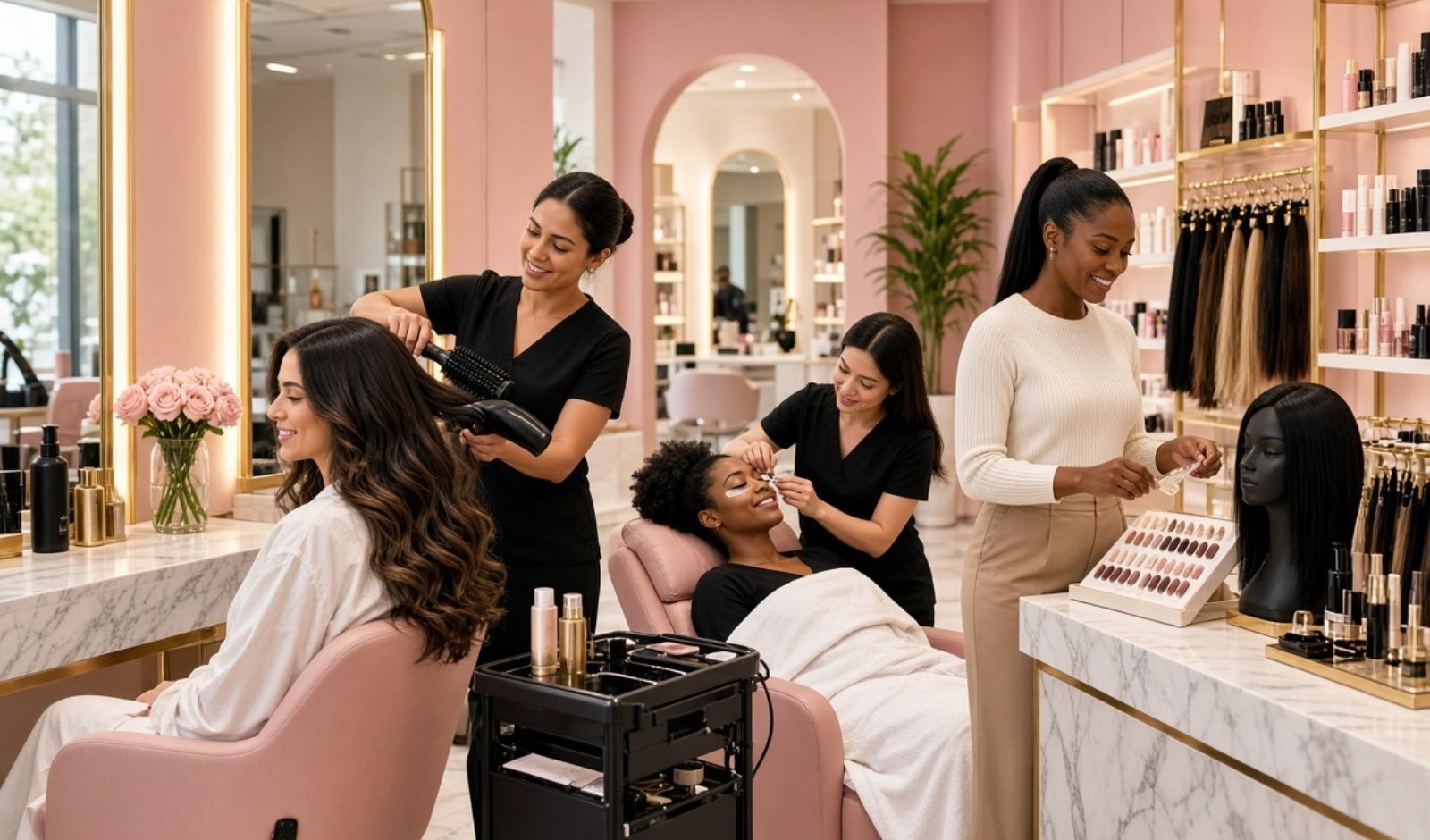
This product-service combination is already visible across the U.S. beauty franchise market.
Drybar, for example, has built its business around professional blowouts and expanded that focused service through a multi-unit franchise model. The brand also sells styling products, extending the customer relationship beyond the appointment.
Deka Lash follows a similar principle by combining specialised lash services with retail products that support customers between visits. Amazing Lash Studio has also built its franchise proposition around recurring eyelash-extension services, while Frenchies Modern Nail Care combines nail services with a membership-oriented customer model.
These businesses are not Chinese beauty brands, but they provide a useful blueprint for what Chinese beauty accessories could add to franchising.
A hair franchise could combine extensions and wigs with professional fitting, styling and maintenance. A nail concept could offer salon appointments alongside curated press-on collections for customers who want an at-home option between visits. A beauty-accessories store could move beyond retail by offering consultations, applications and personalised recommendations.
The commercial model changes as a result. Instead of relying on a single product sale, the franchisee can potentially earn from the service, product, membership, maintenance visit and future appointments.
That recurring relationship is particularly important in franchising because it creates a business model that can be standardised, trained and replicated across multiple locations.
Chinese Consumer Brands Are Already Building U.S. Networks
The beauty opportunity also needs to be viewed against the broader expansion of Chinese consumer brands in the U.S.
Chinese beauty brand Flower Knows entered 450 Ulta Beauty stores across the country in September 2026, following its launch on Ulta.com with more than 60 products in December 2025. The move illustrates how a brand can build an audience through digital channels and then use established physical retail to reach a much larger customer base.
Chinese-origin retailer MINISO provides an even broader example of the physical expansion potential.
MINISO reported 37% year-on-year revenue growth in North America in the first half of 2026, while its U.S. membership base reached approximately 5.8 million, up 107.1%. Its U.S. business combines directly operated locations with retail-partner and distributor models, demonstrating how a Chinese consumer concept can build a sizeable physical network outside its home market.
MINISO is not a beauty franchise, but its expansion is relevant to the larger story. It shows that Chinese consumer brands can move beyond exporting products and establish local retail ecosystems where physical stores, product variety, digital engagement and customer membership work together.
For beauty companies, the next step could be more specialised formats such as standalone beauty stores, salon partnerships, shop-in-shop concepts, area-development agreements or master franchises.
The Franchise Model Could Take the Trend Further
For Chinese beauty brands looking overseas, franchising offers something that e-commerce cannot provide at scale: local operators.
A U.S. franchisee brings knowledge of local customers, real estate, staffing, community marketing and day-to-day operations. The franchisor can provide the brand, training, product standards, technology and supply chain.
That division could be particularly useful in beauty, where customers often want personal advice rather than simply a product delivered to their door.
It also creates opportunities for existing U.S. franchise operators. A salon or beauty franchise does not necessarily need to create a completely new concept to benefit from the trend. Adding selected wigs, extensions, press-on nails, lashes or beauty tools could increase the number of products and services available to existing customers.
The opportunity could therefore work in both directions: Chinese brands can use franchising to enter the U.S., while established U.S. franchise systems can incorporate Chinese-manufactured products into their existing businesses.
The Opportunity Is Bigger Than Low-Cost Beauty
It would be easy to describe the trend simply as Chinese products competing on price. The more important competitive advantage is speed, variety and manufacturing flexibility.
Beauty trends can change quickly. A hairstyle, nail design or accessory can gain attention online and disappear just as quickly. Manufacturers that can respond rapidly have an advantage in a market driven by short social-media cycles.
China’s specialised manufacturing clusters are well suited to that environment, while franchising provides the local layer that manufacturing and e-commerce cannot easily replicate.
A factory can produce thousands of wigs, but it cannot personally fit one for a customer in Dallas. An online seller can demonstrate a nail design, but it cannot provide the same hands-on experience as a professional nail studio.
That gap is where the franchise opportunity sits.
The Supply Chain Will Need to Get Smarter
There are also important challenges. A scalable franchise cannot depend on inconsistent suppliers or products that simply happen to be trending online.
Franchisors need to consider U.S. safety and labelling requirements, product quality, intellectual-property protection, logistics and supplier reliability. Tariffs and changes in international trade policy can also affect sourcing economics.
Centralised procurement and approved supplier networks could therefore become increasingly important. A franchisor that can control product specifications and quality across hundreds of locations has a very different proposition from an independent salon purchasing products from multiple online suppliers.
The winning model will not necessarily be the business that finds the cheapest product. It may be the one that can turn a fragmented global supply chain into a reliable, compliant and repeatable franchise system.
From Viral Product to Franchise Network
The Chinese beauty-accessory boom is ultimately about more than wigs, nails or beauty tools. It reflects a change in how beauty businesses can be built.
China provides manufacturing scale and speed. TikTok and other social platforms provide discovery. Mainstream retailers are providing physical distribution. Beauty franchises provide local expertise, services and recurring customer relationships.
Put those pieces together and a new model begins to emerge.
A customer discovers a product online, visits a local franchise for consultation or application, purchases additional products and returns for another service. The franchisor controls the brand, training, technology and supply chain, while the franchisee builds the local customer relationship.
That is why the Chinese beauty-accessory story matters to franchising.
The opportunity is not simply to sell more products made in China. It is to build businesses around the entire beauty journey; from the viral moment on a smartphone to the service delivered in a local store.
As beauty discovery becomes increasingly digital and product trends move faster, the franchise brands that can connect social commerce, products, professional expertise and physical locations could find a new growth opportunity hiding in plain sight.