
Latin America is becoming a more sophisticated franchise market, but winning there requires local intelligence, not simply exporting a proven business model.
Latin America is no longer a secondary market on the global franchising map. Brazil alone generated R$301.7 billion in franchise revenue in 2025, the first time the sector crossed the R$300 billion threshold, with 202,444 operating units, 3,297 franchising networks and 1.762 million direct jobs. Mexico counts more than 1,500 active brands, roughly 95,000 points of sale and more than one million jobs, contributing around 5% of commercial GDP. Across the region, more than 7,000 franchising brands operate roughly 360,000 points of sale and support an estimated 2.85 million direct jobs, with average annual growth still running above 10.5% in recent years.
This is no longer simply a story of foreign chains planting flags. Brazilian chocolate giant Cacau Show, cosmetics powerhouse O Boticário, Mexican convenience leader Oxxo, Argentine concepts such as Havanna, and Colombian brands including Juan Valdez are expanding aggressively across borders and increasingly writing the regional playbook themselves.
Yet Latin America should never be treated as one franchise market. Brazil operates in Portuguese and has a dedicated franchise statute. Mexico has its own disclosure and contractual framework. Colombia has no dedicated franchise law and relies on general commercial, intellectual-property and contract principles. Currency volatility, taxation, import rules, labour regulation, logistics and consumer behaviour differ substantially from one country to the next. That complexity is precisely what makes the region interesting and demanding.
The World Bank expects Latin America and the Caribbean to grow 2.3% in 2026, with country forecasts of 1.6% for Brazil, 1.3% for Mexico, 2.2% for Colombia, 2.4% for Chile, 2.7% for Peru and 3.6% for Costa Rica. The franchise opportunity is therefore less about explosive emerging-market growth and more about building scalable consumer businesses in large, increasingly formalised markets where established brands can gain share through capable local operators.
Market Reality: One Region, Multiple Business Cases
The first strategic mistake an international franchisor can make is to treat “Latin America” as a single territory.
Brazil is the obvious anchor. Its franchise sector reached R$301.7 billion in 2025, up 10.5% year-on-year, with more than 200,000 operations and nearly 1.8 million formal jobs. Health, beauty and wellness led growth (roughly 14–17%), followed by cleaning and conservation services and food retail/distribution. The Brazilian Franchising Association (ABF) projects another 8–10% revenue increase in 2026. Franchising is also becoming more geographically distributed, now present in thousands of municipalities as brands move beyond the largest capitals into smaller cities, creating space for compact stores, kiosks and lower-capital formats.
Mexico represents another major franchise economy. The AMF describes the country as one of the world’s leading franchise markets (often ranked fifth globally by number of brands). Its ecosystem supports concepts ranging from food and beverage to education, beauty, automotive services, healthcare and professional services. Mexico can also function as a strategic bridge between Latin America and North America, though that advantage should never be confused with permission to impose an unchanged U.S. operating model.
A diverse second tier follows. Colombia combines a large urban consumer base with growing interest in international brands and roughly 550 active franchising networks operating nearly 18,000 establishments and generating more than 70,000 direct jobs. Chile offers comparatively sophisticated retail infrastructure. Peru has developed activity across food, services, education and retail. Central American markets can deliver smaller absolute volumes but attractive entry points for brands using regional or master-franchise structures. Argentina continues to punch above its weight as the region’s leading franchise exporter, with roughly 2,000 brands, 55,800–60,000 points of sale and nearly 264,000 direct jobs by the end of 2025.
Market selection must therefore precede country expansion. Franchisors need to assess addressable consumer segments, disposable income, competition, real-estate costs, supply-chain feasibility, currency exposure, regulatory complexity, digital adoption and the availability of qualified local partners before deciding where and how to enter.
Brazil: Institutional Scale Meets Regulatory Precision
Brazil’s scale can fundamentally reshape an international expansion strategy. Law No. 13.966/2019 provides the region’s most developed legal framework. Franchisors must deliver a Portuguese-language Circular de Oferta de Franquia (COF), the Brazilian equivalent of a Franchise Disclosure Document, at least 10 days before any agreement or payment. The document must include prescribed information, including audited financials and trademark details. The legislation also addresses international agreements, language, forum and arbitration considerations.
For international franchisors, Brazil offers enormous potential but demands serious localisation: Portuguese documentation, local taxation, employment rules, consumer requirements, import economics and intellectual-property protection all need to be built into the market-entry plan from day one. Experienced local franchise counsel should be involved before the first unit is sold, not after.
Mexico: Mature Ecosystem, High Execution Bar
Mexico’s advantages are geography, population scale and deep familiarity with franchising. Its ecosystem is mature enough to support a wide range of concepts, and the AMF’s directory reflects broad category coverage. Franchise agreements and disclosure practices require careful local legal review. Disclosure should address the business model, intellectual property, fees, territory, training, obligations and contractual rights; agreements that function as adhesion contracts can also trigger consumer-protection considerations.
The commercial lesson is straightforward: Mexico may feel familiar to many international brands, but it is not a copy-and-paste market.
Colombia: Contract Discipline as Competitive Advantage
Colombia illustrates why the absence of a single regional regulatory model matters. Without a dedicated franchise statute comparable to Brazil’s, relationships are structured through general contract and commercial principles together with rules on intellectual property, competition, taxation and consumer protection. The contract itself therefore becomes especially important: territory, exclusivity, supply arrangements, minimum performance, marketing contributions, intellectual-property rights, renewal, termination, dispute resolution and post-termination obligations must be drafted with Colombian law and commercial practice in mind.
Brazilian beauty brand O Boticário offers a practical illustration. The company operates in 16 countries with nearly 4,000 stores overall, using a mix of franchising, partner stores, kiosks and other formats. In Colombia it had around 50 stores and more than 1.7 million customer visits in 2025, while developing the market as a key Latin American priority. In 2025 it also introduced its first 360-degree experiential store in the country, combining technology, sensory retail and beauty consultation. The lesson is clear: localisation is not necessarily about changing the brand; it is about changing how the brand is delivered.
Latin America’s Own Brands Are Going Global
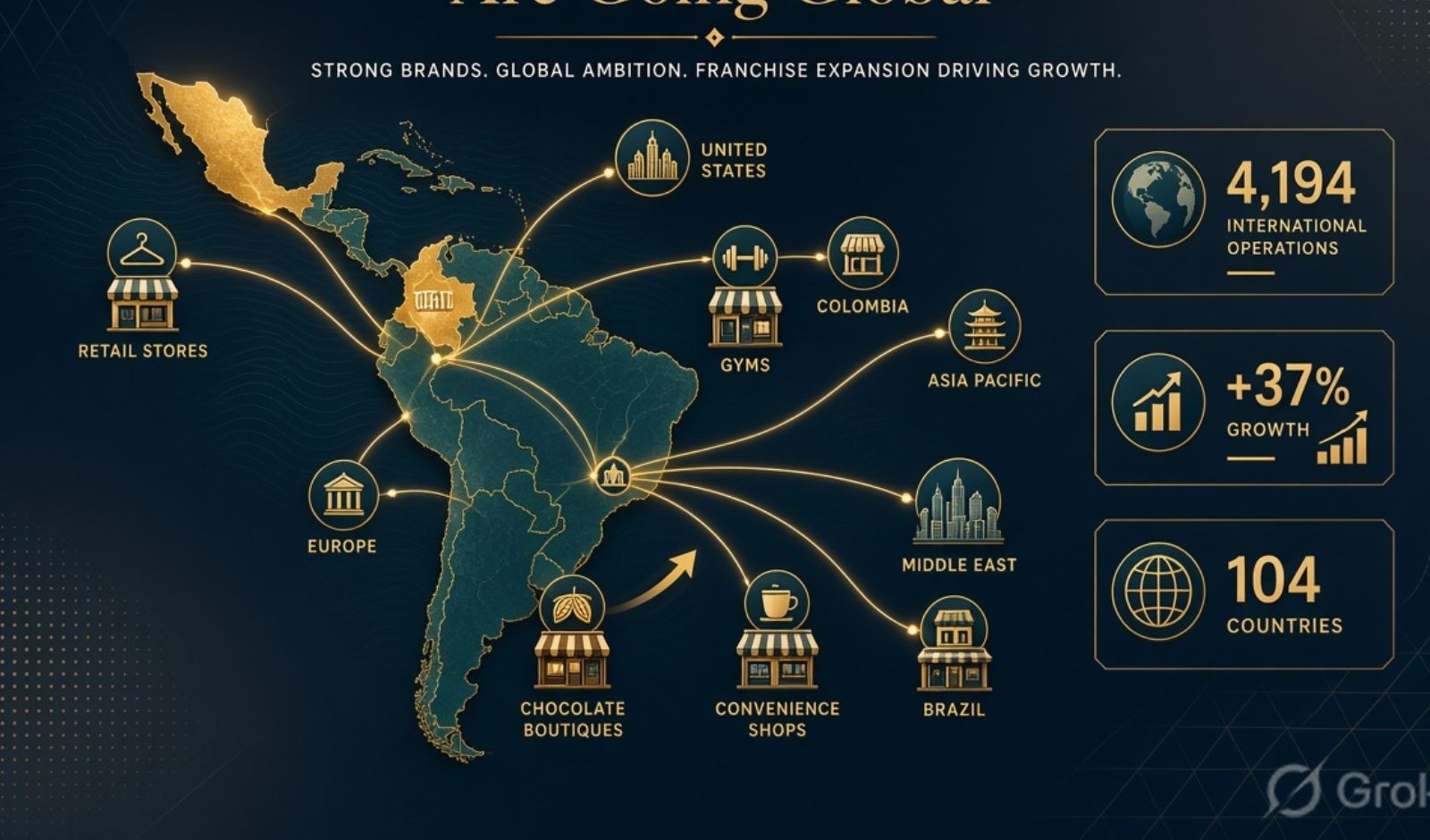
Perhaps the most significant shift is that the region is no longer simply importing franchise concepts. Its own brands are becoming international competitors.
According to ABF’s 2026 internationalisation study, Brazilian franchise brands had 4,194 operations outside Brazil in 2025, up 37% from the previous year, across 104 countries. Formats included franchises, master franchises, area developers, joint ventures and company-owned operations. Mexico and Colombia ranked among the most important Latin American destinations. Leading Brazilian brands such as Smart Fit (986 international operations in the relevant ranking), Oakberry (620), Kumon (337), iGUi (275) and O Boticário (153) demonstrate the breadth of this movement. Cacau Show itself holds the title of Brazil’s largest franchise network by unit count, with 4,713 operations as of early 2026, achieved through flexible formats including container and “smart” stores plus multi-franchisee strategies.
Oxxo, operated by FEMSA, provides another regional benchmark: roughly 24,700 stores in Mexico by mid-2026 and closing in on the 25,000-store milestone, while expanding in Brazil, Colombia (targeting more than 700 units), Chile, Peru and the United States.
This matters for international franchisors because the competitive landscape is changing. A U.S., European or Asian brand entering Latin America may no longer compete only against other foreign systems. It may face sophisticated regional operators that already understand local consumers, real estate, labour markets and supply chains exceptionally well.
Structuring Growth: Master Franchise vs Controlled Expansion
For many brands the biggest strategic decision is not whether to franchise but how to franchise.
A master-franchise structure can deliver rapid geographic coverage without building large corporate infrastructure in every market. The local master franchisee may recruit sub-franchisees, develop territory, manage training and provide ongoing support. The model, however, inserts a second layer between franchisor and unit operators, making partner selection critical. The ideal master franchisee needs more than capital: local market knowledge, development capability, real-estate access, operational management, recruitment capacity, financial strength and the ability to build a genuine franchise-support organisation.
Area-development agreements can offer tighter control while still transferring development responsibility. In higher-uncertainty markets, a staged approach is often wiser, begin with company-owned or pilot locations, validate the proposition, refine pricing and supply chains, then scale through franchising.
Unit Economics Depend on Supply Chain and Localisation
A franchise concept that works brilliantly at home can fail internationally because its economics depend on a supply chain that does not travel. Latin American countries vary widely in geography, infrastructure, import procedures, taxation and currency. Food brands must determine which ingredients can be sourced locally without compromising specifications. Retail brands must weigh duties, freight, taxes and exchange-rate exposure. Service businesses face fewer physical supply-chain issues but significant requirements around training, labour and technology.
The practical solution is often a hybrid architecture: core products, technology, brand assets and proprietary inputs remain centrally controlled, while non-critical inputs are localised. This reduces landed costs and foreign-exchange exposure while increasing responsiveness to local consumers.
Consumer localisation goes beyond language. Brazil requires Portuguese; even Spanish-speaking markets differ in vocabulary, purchasing behaviour, food preferences, payment habits and cultural expectations. The strongest approach is standardisation of the operating system combined with localisation of the customer experience; menus, store formats, class schedules, product ranges, service protocols and partnerships.
Data and Digital as Operating Leverage
Digital franchising is becoming a regional advantage. Brazilian growth has been supported by digitalisation and omnichannel development. Franchisors that build centralised platforms for CRM, loyalty, ordering, marketing automation, franchisee reporting, inventory and performance dashboards gain network-level data visibility. The competitive edge increasingly belongs to systems that turn data from hundreds of locations into better decisions on site selection, coaching and territory planning. Artificial intelligence can further improve demand forecasting, inventory management, location evaluation and anomaly detection.
Execution Checklist for International Franchisors
There is no regional shortcut. Before entering, a franchisor should establish a country-level investment thesis rather than a generic Latin American expansion plan. That thesis must cover market size, consumer segments, competition, unit economics, real-estate availability, supply-chain structure, taxes, labour, intellectual property, foreign-exchange exposure and regulatory obligations.
The franchise agreement, disclosure package, operating manual, training, marketing strategy, technology stack and financial model should all be localised. Unit economics must be modelled in local currency and stress-tested against inflation, exchange-rate movement, wage increases, rent escalation, import costs and shifts in consumer demand.
Most importantly, franchisors must avoid confusing franchise sales with franchise development. Selling ten licences is not the same as building ten successful businesses. The real test is whether franchisees can achieve sustainable unit economics while maintaining brand standards.
From Market Entry to Portfolio Discipline
Latin America’s franchise opportunity is becoming more sophisticated rather than simply larger. Brazil demonstrates the scale franchising can achieve. Mexico demonstrates the depth of a mature ecosystem. Colombia shows how international brands can adapt formats and experiences. Brazilian brands such as Smart Fit, Oakberry, Cacau Show and O Boticário prove that Latin American systems themselves can become global competitors.
For international brands the opportunity is therefore not to “enter Latin America” as one market. It is to identify the right country, the right city, the right partner and the right operating model and then build outward. That may mean Brazil first, Mexico, a smaller market with less intense competition, a master franchise, an area-development model, a joint venture, or company-owned pilots before franchising.
What matters is that the strategy is designed around the economics and realities of the market rather than assumptions imported from the home country. Latin America has the scale, entrepreneurial culture and increasingly sophisticated franchise infrastructure to support major international expansion. The brands most likely to win will be those that understand a fundamental distinction: global franchising is about replicating a system; successful international franchising is about adapting that system intelligently.