
China’s restaurant market is still expanding, but the next growth cycle is being driven by scale, franchising, value and increasingly sophisticated local partnerships.
China’s foodservice market has entered 2026 with a very different growth equation from the one that attracted international restaurant companies a decade ago. The opportunity remains enormous, but expansion is no longer enough. Restaurants are operating in a market where consumers are more price-conscious, competition is intense and operators need scale, technology, supply-chain efficiency and strong unit economics to survive.
China’s catering revenue reached RMB5.798 trillion (US$805 billion) in 2025, up 3.2% year on year, according to the National Bureau of Statistics. In the first half of 2026, catering revenue reached RMB2.826 trillion, up 2.8% from the same period a year earlier.
The more important change for franchising, however, is happening beneath the headline market size. China’s restaurant chainization rate reached 25% in 2025, up from 21% in 2023 and 15% in 2020, according to data from the China Chain Store & Franchise Association and Meituan cited by China Daily and the USDA Foreign Agricultural Service. Milk-tea shops and cafés have a chain penetration rate of 49%, followed by baked-dessert shops at 34% and snack/fast-food outlets at 29%. Western restaurants, by comparison, stood at 17%.
That makes 2026 less a story about China’s restaurant market simply getting bigger and more a story about who has the systems to capture that growth.
China Is Moving From Fragmentation to Scale
The pressure behind consolidation is substantial. China’s restaurant sector reached an estimated 16 million establishments in 2024, an all-time high, yet the average lifespan of a restaurant fell sharply from 2.1 years in 2015 to 16.9 months in 2024, according to the USDA Foreign Agricultural Service. The USDA expects the average lifespan to decline further to around 15 months, underscoring the increasingly competitive operating environment.
The scale of business turnover is equally striking. Nearly 3 million catering companies were dissolved in 2024, according to corporate-registration data from Qichacha cited in Chinese industry reporting. At the same time, more than 400,000 new catering-related enterprises were registered during the early part of 2025, highlighting the intense churn within the sector. The combination of weaker consumer spending, aggressive price competition and pressure on operating margins is forcing restaurants to compete more heavily on value while making scale, efficiency and cost control increasingly important.
This is the environment in which chain restaurants are gaining structural advantages. Larger networks can centralize procurement, negotiate with suppliers, spread technology and marketing costs across hundreds or thousands of units, and use data to optimize menus, locations and pricing.
The 25% chainization figure is particularly important for franchising. It does not mean that one-quarter of China’s restaurants are franchised; chainization includes both company-operated and franchised networks. What it does show is that China’s restaurant market is becoming more standardized and brand-led, creating better conditions for franchise models that can demonstrate repeatable economics.
The opportunity is also not confined to China’s traditional first-tier cities. The USDA found that chain penetration is particularly strong in beverage and fast-food categories, while major Chinese operators have been using smaller formats to reach lower-tier cities.
For international franchisors, that changes the strategic question. China is no longer simply a market in which a recognizable foreign brand can open stores and expect demand to follow. It is a market where the brand must fit into an increasingly competitive, value-driven and highly localized operating system.
U.S. Chains Are Returning, But With Bigger Franchise Bets
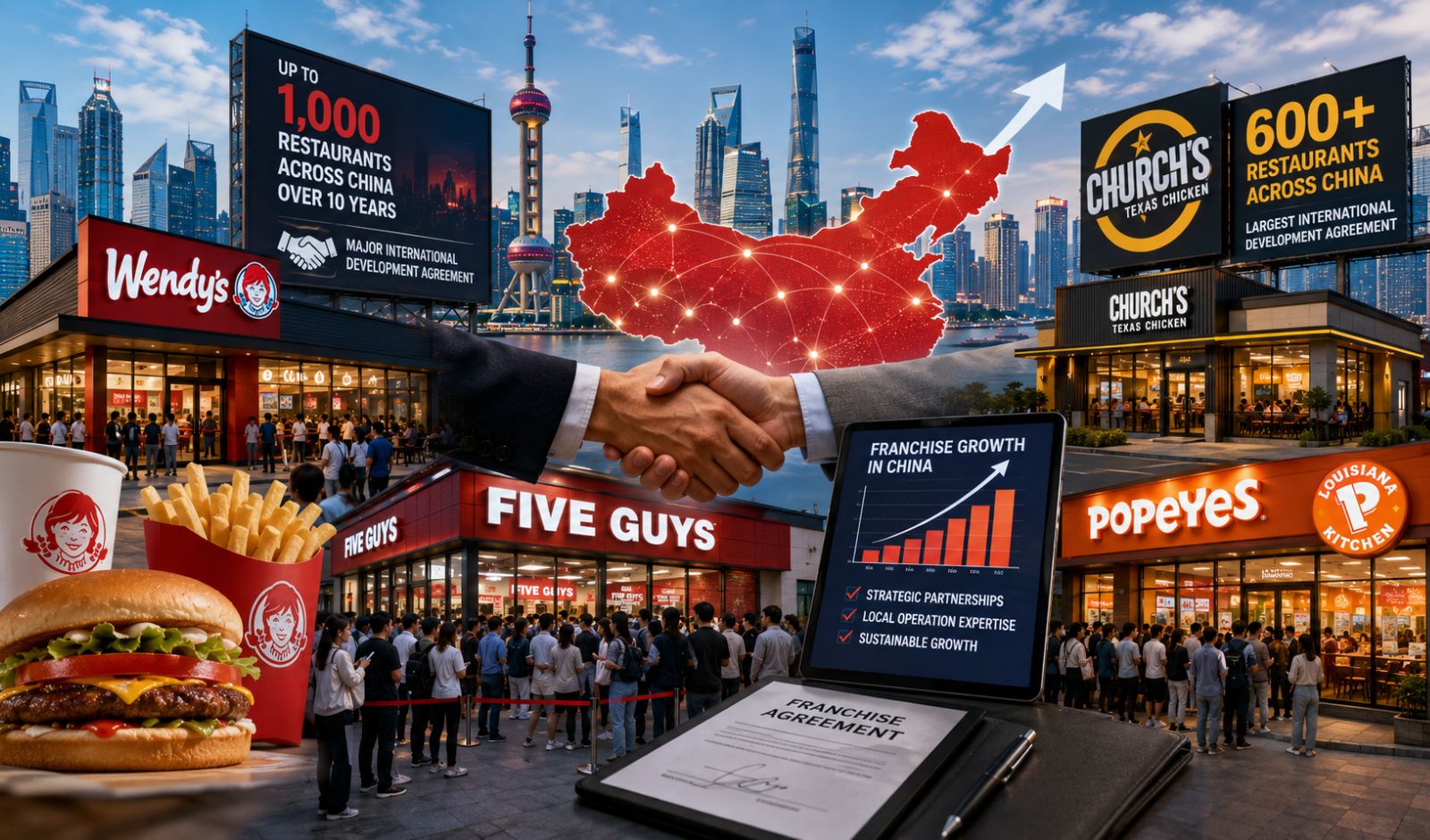
The most visible sign of renewed international confidence is the number of American restaurant brands either entering China, returning to cities they previously left or significantly increasing their development ambitions.
Wendy’s provides perhaps the clearest example of the new franchise-led approach. In May 2026, The Wendy’s Company signed a franchise agreement to build up to 1,000 restaurants across China over the next 10 years with an experienced restaurant operator. Wendy’s described it as a major international development agreement and said the partner brings extensive experience operating in China.
The announcement came as Wendy’s was experiencing considerable pressure in its U.S. business. In the first quarter of 2026, U.S. same-restaurant sales fell 7.8%, while international systemwide sales increased 6%. That contrast makes the China agreement particularly significant as part of the company’s international growth strategy.
Church’s Texas Chicken has made an even more direct commitment. In April, the brand signed a franchise agreement with Chinese operator Deke Shengtang to develop 600 or more restaurants across China over the coming years. Church’s described it as its largest international development agreement to date.
The significance of these deals goes beyond the numbers. Both demonstrate that international restaurant brands are increasingly entering China through experienced local franchise operators, rather than attempting to build entire networks themselves.
Five Guys, meanwhile, is expanding rather than making a new market entry. After entering Shanghai in 2021, the U.S. burger chain opened its first two Beijing restaurants on August 3, 2026, at Xidan Joy City and Chaoyang Joy City. The openings drew large crowds, and the company said it expected to have three Beijing stores operating by the end of September while continuing expansion across eastern China.
Popeyes represents the most literal “return” story. The brand returned to Beijing in 2026 after previously leaving the city, as international fast-food operators once again look to major Chinese urban markets and beyond.
Together, Wendy’s, Texas Chicken, Five Guys and Popeyes point to a broader shift: China is not being treated as a closed chapter by U.S. food brands. It is being approached as a second-generation growth market requiring a more sophisticated entry model.
Local Capital and Partnerships Are Redefining International Expansion
The strongest evidence of this change comes from brands that already have significant footprints in China.
Burger King completed a new joint venture with Chinese investment firm CPE in February 2026. CPE invested $350 million in primary capital, while the partnership aims to expand Burger King China from approximately 1,250 restaurants to more than 4,000 by 2035. The transaction also includes a 20-year master development agreement.
Starbucks has taken an even more dramatic step toward local participation. In April, it finalized its joint venture with Boyu Capital, under which Boyu-managed funds hold 60% of Starbucks’ China retail operations and Starbucks retains 40%. The joint venture covers approximately 8,000 existing coffeehouses and has a long-term aspiration to reach as many as 20,000 locations. Starbucks continues to own and license its brand and intellectual property.
This structure is important because it separates brand ownership from local operating capital and execution. Starbucks retains its intellectual property and a significant economic interest, while its Chinese partner brings local investment and market expertise.
Pizza Hut is another example of China becoming increasingly locally controlled. On August 7, 2026, Yum! Brands completed the $1.2 billion sale of Pizza Hut China to Yum China, transferring ownership of the Pizza Hut brand in mainland China to the company that has operated the business there for decades.
Yum China had 4,549 Pizza Hut restaurants at the end of June, and the company has said the acquisition should provide greater flexibility in areas including menus, formats and development while eliminating licensing payments to Yum! Brands.
The Pizza Hut transaction therefore represents more than an M&A deal. It reflects the increasing maturity of China’s restaurant market: international brands can still create enormous value there, but local ownership and operating capabilities are becoming increasingly important to capturing it.
Franchising Is Becoming a Growth Engine, Not Just an Entry Strategy
Yum China’s current expansion illustrates how quickly franchising is becoming embedded in the economics of large restaurant systems.
At the end of June 2026, Yum China had 19,297 restaurants across its portfolio. It opened a record 560 net new stores in the second quarter, while franchisees accounted for 41% of those openings. Approximately 18% of the company’s total stores were operated by franchisees at June 30.
Yum China’s strategy is increasingly built around different formats for different consumer and geographic segments. KFC Small Town and Pizza Hut WOW, for example, are designed to make expansion into lower-tier markets more capital-efficient. The company has previously said franchise stores can help it reach lower-tier cities, remote areas and strategic locations that would be harder to cover through a wholly company-operated model.
The company has also been increasing the proportion of new Pizza Hut restaurants developed through franchisees, targeting a 40% to 50% franchise mix for net new Pizza Hut stores, broadly aligned with KFC’s approach.
That is a significant development for the wider franchise industry. China is moving from a model in which franchising is primarily a tool for smaller brands or market entrants toward one where even enormous restaurant systems use franchise capital to accelerate geographic penetration.
It also explains why international brands such as Wendy’s and Texas Chicken can announce hundreds of planned stores without committing equivalent levels of corporate capital.
Value Is Now as Important as Brand Recognition
The biggest obstacle for U.S. chains in China may not be consumer awareness. It is value.
China’s consumers are increasingly willing to trade down, compare prices and switch between brands. Delivery platforms have intensified this behaviour, while restaurant operators have competed aggressively for traffic.
The result can be seen in Yum China’s 2026 performance. In the second quarter, KFC system sales increased 7% year on year, while average ticket declined 3%. Pizza Hut system sales increased 6%, with transactions benefiting from a more value-oriented strategy.
Digital ordering has become central to that equation. Delivery sales represented approximately 54% of KFC company sales and around 52% of Pizza Hut company sales in the second quarter, illustrating how deeply off-premise consumption has become embedded in the operating model.
Pizza Hut is also expanding beyond its traditional price and product positioning. Its Burger Bar format had surpassed 200 locations within six months, with plans to reach 500 to 600 locations by the end of 2026.
The burger opportunity itself is substantial. It was reported on August 17 that China’s burger market was valued at approximately $18.4 billion in 2025 and is projected to expand at an annual rate of 8.7% through 2035. Burgers had the highest level of consumer interest among fast-food categories in a 2025 survey, at 55%, while 43% of Chinese consumers reportedly order food delivery at least weekly.
That helps explain the influx of burger concepts, but it also illustrates the challenge facing international brands. They are entering categories that are already crowded with aggressive domestic competitors.
Chinese Chains Are Setting the New Benchmark
The strongest evidence of China’s transformation comes not from international companies but from domestic chains that have achieved extraordinary scale.
Luckin Coffee ended 2025 with 31,048 stores globally, including 8,708 net new openings during the year. Of those openings, 8,599 were in China, including Hong Kong. Its 2025 revenue reached RMB49.288 billion, an increase of 43% year on year.
Mixue offers an even more powerful example of China’s franchise-led expansion model. At the end of 2025, it had 55,356 stores on the Chinese mainland, spanning 31 provincial-level regions and more than 300 cities. About 58% were in third-tier cities and below. During the year, Mixue opened 14,496 new franchise stores and closed 2,527, producing a net increase of roughly 12,000 locations.
Those figures demonstrate what international brands are now competing against: domestic companies capable of combining low price points, rapid product innovation, digital ordering, franchise development and highly integrated supply chains.
For U.S. brands, localization is therefore no longer simply about adding a few Chinese menu items. It means adapting the entire business model, from price architecture and store formats to delivery, digital loyalty, supply chain and franchise economics.
What the Next Franchise Cycle Looks Like
China’s food franchising market is not entering another uncontrolled store-opening boom. It is entering a scale-and-selection phase.
The market itself continues to grow: catering revenue increased 3.2% in 2025 to RMB5.798 trillion, while the first half of 2026 produced another 2.8% increase. But the combination of intense competition, restaurant closures and rising chainization means growth is increasingly flowing toward operators with the ability to standardize and scale.
That is why the most important franchise developments of 2026 are not simply new store openings. They are large development agreements, joint ventures, local ownership changes and accelerated franchise penetration.
Wendy’s has committed to up to 1,000 restaurants. Texas Chicken has signed for 600 or more. Burger King is targeting more than 4,000. Starbucks sees a potential path from approximately 8,000 to as many as 20,000 locations. Yum China is pushing toward 20,000-plus restaurants across its system while increasing franchise participation.
But the domestic market has changed the rules.
The brands most likely to succeed in China’s next franchise cycle will be those that combine international brand equity with local operating expertise, accessible pricing, flexible store formats, strong franchisee economics and highly developed digital and supply-chain systems.
China is still a huge growth opportunity for food franchising. What has changed is the definition of opportunity. The market is no longer waiting for foreign brands to arrive. Chinese chains have already built the infrastructure, consumer habits and competitive benchmarks.
The next generation of international winners will have to operate within that ecosystem, not around it.
In 2026, consolidation is not closing China’s door to food franchising. It is making the door narrower, more competitive and potentially much more valuable for brands that can scale intelligently.